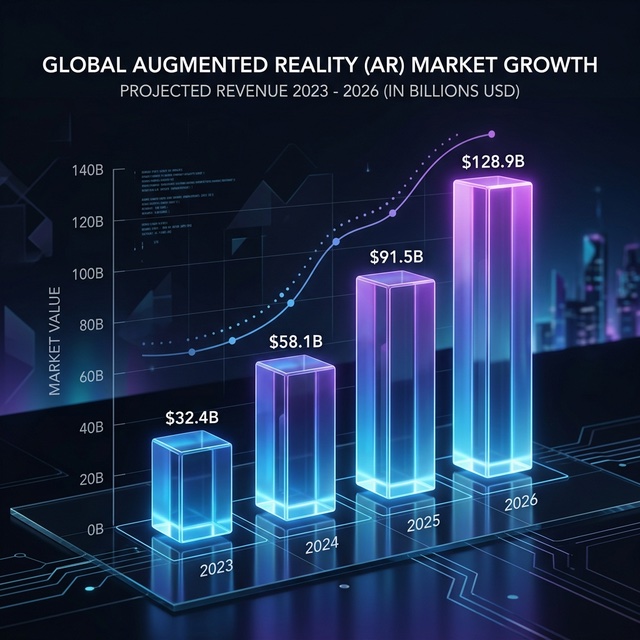
The technology world is undergoing a massive transformation as we approach the mid-2020s. Once seen only in science fiction movies, Augmented Reality (AR) has evolved from a niche toy into a cornerstone of the global economy. By 2026, we see that this technology is not just a trend but a standard that fundamentally changes how we do business.
1. 2026 Market Size: The Future in Numbers
According to various market research reports, the global AR market is expected to reach a valuation of $89 billion to $125 billion by 2026. This growth represents a massive annual average growth rate (CAGR) of 30%-46%.
Software and platform services are expected to grow faster than hardware, opening doors for more accessible and scalable AR solutions for businesses of all sizes.
References and Data Foundations:
- MarketsandMarkets: Global AR Market Forecast
- KBV Research: Augmented Reality Market Size & Trends
- Mordor Intelligence: AR Industry Analysis
2. Sectoral Breakdowns: What is AR Changing?
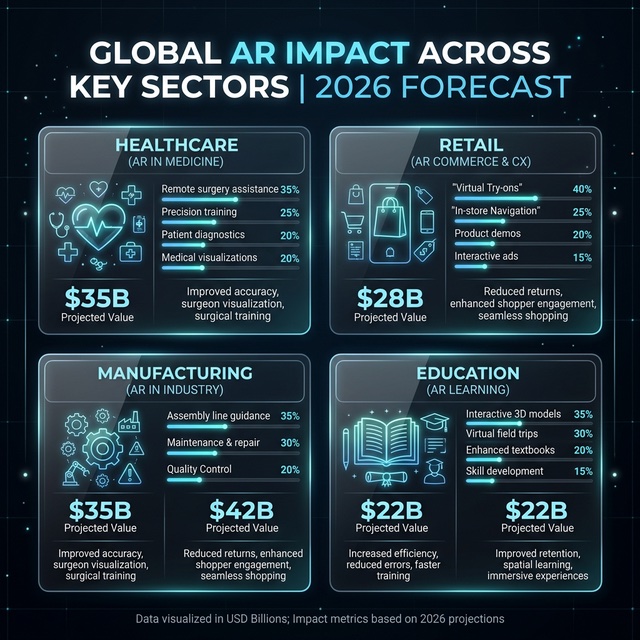
AR technology does not touch every sector in the same way. Some industries are pioneers of this transformation. Here is the sectoral impact distribution according to 2026 projections:
Healthcare
Surgeons can now track a patient's anatomy in real-time via AR glasses during operations. Remote diagnostics and medical education are becoming error-free thanks to the 3D models provided by AR.
Retail and E-Commerce
The "Try-before-you-buy" model is no longer a luxury but a necessity. Virtual fitting rooms and furniture placement applications have reduced return rates by up to 30%.
Manufacturing and Industry
Thanks to industrial "Digital Twin" applications, technicians can see the internal structure of complex machines without dismantling them and work with zero errors using AR-supported assembly guides.
Education
Static books are giving way to interactive 3D course materials. History lessons transform into a journey to the past with AR, while biology lessons become an exploration into the cell.
3. Hardware and Connectivity: The Power of 5G
The biggest driving force behind the widespread adoption of AR in 2026 is 5G and Edge Computing technologies. Low latency and high data speeds allow AR experiences to be processed instantly over the cloud. Lighter and more cost-effective versions of devices like Apple Vision Pro and Microsoft HoloLens have put AR into the pockets (and eyes) of end-users.
Conclusion: Are You Ready for an Augmented World?
In 2026, augmented reality is not just a visual feast but an indispensable tool for efficiency and user experience. Whether your business is a small consulting firm or a giant manufacturing plant, investing in AR technology is no longer an option, but a requirement for competition.
Don't wait for the future; build it now with augmented reality.
For more information and your AR projects, you can contact the cxocARd team.